Blog

April Garden Bloggers’ Bloom Day

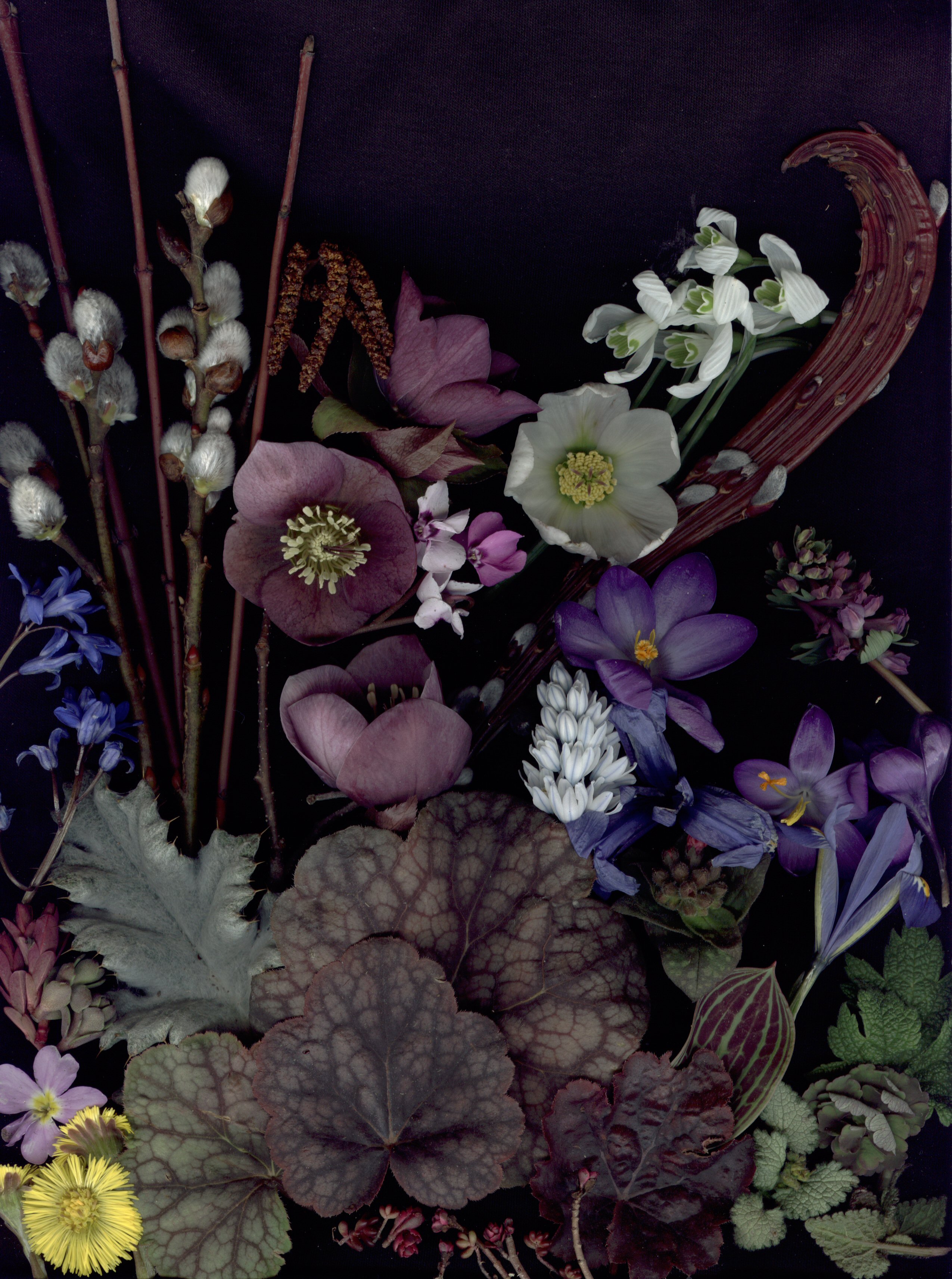
scan of april blooms
Larger image
| Extra large image [1.4MB]
For more about this technique, see Scanning Flowers.

With the cold weather this week, the garden has been in a state of suspended animation. No daffodils or tulips yet, though the former are budding and the the latter did add some leaf.

Small, low-growing spring ephemerals are about all that’s flowering. Various iris are past their prime, most having been damaged by temps in the teens. (Same goes for crocus.) Snowdrops are also past their prime on the south side, but in their prime on the north side of the house. Hellebores are peaking. Pulmonaria, primula and corydalis are coming on. Cyclamen continue to bloom, as they have most of the winter. Coltsfoot flowers show up here and there. Willows are still putting on a show.

This time of the year, foliage adds to the display. Old and new heuchera leaves. Lamium. Scotch thistle. Emerging sedums.

It was nice to do a little garden clean-up today. The soil is still a little on the wet side. Now I’ll say good-bye to the ground for awhile, what with a foot of snow predicted for Sunday and Monday.

Sunday music two-fer: Bright Eyes, Jenny Lewis

Jenny Lewis and the Watson Twins’ Rabbit Fur Coat got my vote for album of the year in 2006. Interesting to see how the next generation deals with spirituality in this age of cynicism.

See also Rise up with fists, You are what you love and Fernando

I always thought we’d look back at this performance as a sign that we’d reached the tipping point, and it was just a matter of time before the politicians joined the people’s parade. I mean Jay Leno having Bright Eyes sing ‘When the President Talks to God’?

Kurt Vonnegut, RIP

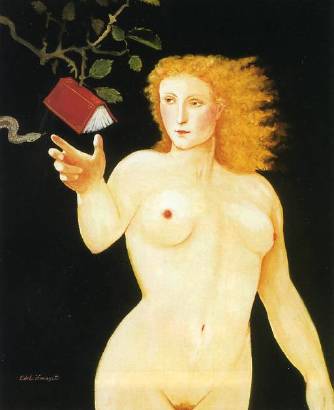
Edith Vonnegut detailThe excerpt below was posted by atrios this morning. It’s from Slaughterhouse Five, or the Children’s Crusade and is one of my favorites. The image is a detail from Edith Vonnegut’s (Kurt’s daughter) illustration for The Idea Killers. Full image.

Rosewater was on the next bed, reading, and Billy drew him into the conversation, asked him what he was reading this time.

So Rosewater told him. It was The Gospel from Outer Space, by Kilgore Trout. It was about a visitor from outer space, shaped very much like a Tralfamadorian, by the way. The visitor from outer space made a serious study of Christianity, to learn, if he could, why Christians found it so easy to be cruel. He concluded that at least part of the trouble was slipshod storytelling in the New Testament. He supposed that the intent of the Gospels was to teach people, among other things, to be merciful, even to the lowest of the low.

But the Gospels actually taught this:

Before you kill somebody, make absolutely sure he isn’t well connected. So it goes.

The flaw in the Christ stories, said the visitor from outer space, was that Christ, who didn’t look like much, was actually the Son of the Most Powerful Being in the Universe. Readers understood that, so, when they came to the crucifixion, they naturally thought, and Rosewater read out loud again:

Oh boy – they sure picked the wrong guy to lynch that time!

And that thought had a brother: “There are right people to lynch.” Who? People not well connected. So it goes.

The visitor from outer space made a gift to Earth of a new Gospel. In it, Jesus really was a nobody, and a pain in the neck to a lot of people with better connections than he had. He still got to say all the lovely and puzzling things he said in the other Gospels.

So the people amused themselves one day by nailing him to a cross and planting the cross in the ground. There couldn’t possibly be any repercussions, the lynchers thought. The reader would have to think that, too, since the new Gospel hammered home again and again what a nobody Jesus was.

And then, just before the nobody died, the heavens opened up, and there was thunder and lightning. The voice of God came crashing down. He told the people that he was adopting the bum as his son, giving him the full powers and privileges of The Son of the Creator of the Universe throughout all eternity. God said this: From this moment on, He will punish horribly anybody who torments a bum who has no connections!

Billy’s fiancee had finished her Three Musketeers candy bar. Now she was eating a Milky Way.

“Forget books,” said Rosewater, throwing that particular book under his bed. “The hell with ’em.”

“That sounded like an interesting one,” said Valencia.

“Jesus-if Kilgore Trout could only write!” Rosewater exclaimed. He had a point: Kilgore Trout’s unpopularity was deserved. His prose was frightful. Only his ideas were good.
Update: Jon Stewart interviews Vonnegut on The Daily Show via Crooks and Liars.

Thoughts on Flower Confidential

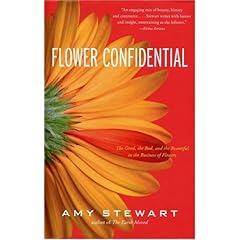
Flower ConfidentialFull disclosure: My wife is allergic to flowers. I never bring them in the house. The only times I’ve purchased flowers were a corsage for the senior prom and an internet mail-order orchid plant for my left-coast sister when she got married a few years ago.

I finally finished reading Amy Stewart’s Flower Confidential this week. It’s not that it wasn’t a page-turner for this guy who’s only payed for flowers twice. It was. I’m just a slow reader when it comes to bed-side books.

I’d compare Amy’s book to works by my first favorite non-fiction writer, John McPhee. McPhee had a talent for writing at length about subjects that I wasn’t sure I was interested in — looking at them from every point of view — and making me glad I savored every page. Amy is similarly talented.

The story she tells is so familiar to me. I couldn’t help but draw parallels at every turn with the organic farmers I worked with in the ’80s and ’90s. That was a time when the globilization of agriculture and commoditization of foodstuffs like corn and soybeans (which had begun decades earlier) became totally accepted as business as usual. At the same time, there were (relatively) small voices screaming that maybe this isn’t such a good thing.

It was a time when the slow but steady growth of organic farming was starting to pick up steam. There was a recognition that there was a small group of consumers who wanted something different — something fresh, local, and in-season. Something flavorful. And something grown with a recognition that buying foods raised in certain ways can help heal the huge negative impacts on people and the land caused by other ways of farming.

The main take-home from Amy’s writing is that flowers have become faceless global commodities — just like corn and beans. With the availability of rapid shipment from growing areas to consumers, production will continue to slide to wherever labor is cheapest and environmental standards the most lax. Even with rising energy costs for transportation, flowers are a relative bargain to move around. Shipping something that’s worth a dollar a stem makes a lot more sense than moving around corn grain, for example. When corn sells for $2 a bushel, a bucks-worth weighs 28 pounds.

Another tidbit that caught my eye: Half of flower sales are on Valentine’s Day? Take a clue from the turkey industry and figure out a way to spread sales through the year.

If I was a flower-buyer, I think I would be as likely to buy a rose in February as I would be to buy a package or rock-hard tomatoes at that time of the year.

So now the floral industry is moving to certify flowers produced in more loving ways. That’s a good thing because it give consumers a chance to exercise at least some degree of choice about how the flowers they buy are grown. But ask any long-time organic farmer what they think of corporate agriculture getting into organic farming. It hasn’t been pretty.

I would never suggest that folks stop buying flowers. It wouldn’t do any good. People love flowers. But I would suggest folks vote with your purchases to help foster a sensible sustainable ‘flower system’: In order: