Blog

Arborsculpture blog

wilma erlandson

I stop by from time to time to visit Richard Reames’ Arborsmith Studios website because I’m fascinated by the ways that he and others can turn living trees into art. He devotes a page to one arborsculpture pioneer and favorite of mine, Axel Erlandson, and links to other arborsculpture artists around the world.

Erlandson started bending, shaping and grafting trees in the ’20s, and opened his ‘Tree Circus’ attraction in 1947 on the well-traveled route between the Santa Clara Valley and the Pacific coast. That’s his daughter, Wilma, who wrote “My Father Talked to Trees.” Reames sells that book, his own Arborsculpture – Solutions for a Small Planet and other books and supplies at his site.

As I was surfing once again through the links on Reames funky and fun site, I was happy to find that he started new Arborsculpture blog, apparently last winter. Worth adding to your RSS feeds if you are interested in this kind of stuff, and who isn’t?

Here’s a short (3:39) video by Reames:

Sod sculpture at Bluegrass Lane

sod sculpture and artistes

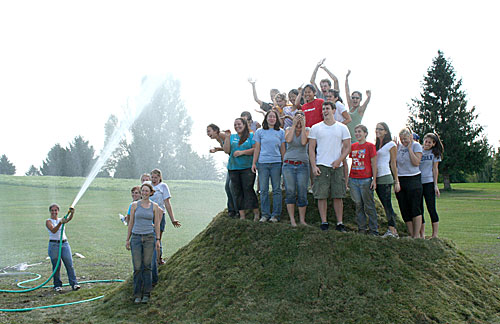
Yesterday, students in my friend Marcia Eames-Sheavly’s Art of Horticulture class made a sod scuplture (with help from our ‘Turf Guy’ Frank Rossi) at Cornell’s Bluegrass Lane Turf and Landscape Research Center. Unfortunately, by the time I got my office work under control and headed out to observe, they were done. But teaching assistant and grad student extraordinaire Chad Miller graciously shared his images with me. Here’s a small photo gallery showing the process.

Update: Nice article in the Cornell Chronicle.

Plants in motion

Some people are drawn to birding over gardening because ‘birds move, plants don’t.’ Au contraire. I am acutely aware of motion in the garden, and enjoy many plants for the mere fact that they start quivering in the slightest breeze.

For example, I’ve heard folks disparage Calamagrostis because most of the time it just looks like dead grass. But it’s the first plant that starts in motion when there’s not even enough wind to get the wind chimes playing. Here it is with a white-flowered artemisia in the foreground:

Ornamental grasses are generally the best for turning wind into motion. There are several here, with Calamagrostis (left) wavering again, Miscanthis (several, center) flying its flag, and Panicum (right) reacting en masse.

[A technical note: I’m very unhappy about the loss of quality when video files are uploaded and compressed by both GoogleVideo and YouTube. It helped to cut back to 15 fps when filming, but still the raw avi files or edited wmv files look much better viewed locally. If you squint viewing these, you’ll probably get the idea. Anyone have tips for maintaining quality when uploading to either of these sites?]

Floppers — those top-heavy plants that most people stake (I sure don’t have the time) — are fascinating in a light breeze. (All of these videos were shot on days when there were only intermittent breezes topping out at about 10 mph.) Here is Rudbeckia laciniata ‘Hortensis’ (the outhouse plant I blogged about recently) bobbing and weaving in a slight breeze.

Here’s Sanguisorba tenuifolia (also the subject of a recent post) which really gets going with just a whisper of a wind. And if you squint, you can see another great top-heavy flopper bobbing around, Joy-pye weed (Eupatorium spp) left background.

Here’s a close-up of the same Sanguisorba, which will give you a good idea of just how much this plant moves in just a very light breeze.

Big leaves are also good at catching a breeze. Tropical plants like elephant ears (left) and bananas (right) start quivering with the slightest breeze.

Mixed plantings give interesting effects. (Hey, you choose plant combinations based on color. Why not on how they move?) There are tall, top-heavy ironweed (Vernonia) in the center of this planting and goldenrod to the left. More Calamagrostis waving down low, left-center with a bluish Panicum behind it. Various shrubs, trees and weeds add to the effects.

Dappled shade can heighten the effects of motion as the overstory moves along with (or counter to) the plants below, which move in and out of light and shade, like these coneflowers.
Replacing Neglect With Peach Trees

NY Times photo
NY Times photo

I don’t usually read the NY Times real estate section (I guess I guy can dream, but I’m never gonna live in any of those houses). So I missed this article about former-Ithaca activist Paul Glover’s efforts to plant orchards on vacant lots in Philadelphia.

Susan M. Wachter, a professor of real estate finance at the Wharton School of the University of Pennsylvania, … found that cleaning up vacant land raised the value of adjacent homes by 20 percent.

[She also] found that planting trees on residential blocks citywide raised property values on the block by almost 10 percent. The increased market values are attributable to a “combination of landscape changing dramatically, and also a signal that someone is reinvesting in the neighborhood,” Ms. Wachter said.

The article mentions similar pioneering efforts in Austin and other cities.

Glover is famous here in Ithaca for inventing Ithaca Hours, a local bartering currency.