Blog

Future Food

Feeding People is EasyThis post was triggered by Amy Stewart’s ‘bored with the whole locavore thing‘ commentary on NPR’s All Things Considered and the ensuing discussion over at GardenRant.

When the whole local foods thing comes up, I am reminded of one of my favorite books 30 years ago, Future Foods (1980, apparently republished as Future Cooks sometime since then). This a cookbook/polemic from British science writer Colin Tudge posited we should should think of our foods as divided into three categories:

Foods of the first kind:

These are the grains and vegetable proteins that form the basis of every traditional cuisine in the world. If you live in Asia, it’s mostly rice and soybeans. In Latin America, corn tortillas and beans. In the Middle East, lentils and wheat.

Tudge argues that — for mostly geopolitical reasons — every country (indeed every region) should be self-sufficient in these crops that are locally adapted, storable and provide the calories and protein people need to stay alive. He also argues that meals based primarily on these foods can be healthy and tasty.

Despite Tudge, foods of the first kind play little role in the locavore movement.
ward and cassFoods of the second kind:

These are the fruits, vegetables, nuts and animal products (meat, dairy, eggs) that provide concentrated sources of vitamins, complete protein and flavor. Adding these to foods of the first kind take you from survival rations to healthy diet. Still, they should be considered supplements, not the center of the diet.

Tudge argues that most of these should be local as much as possible. But he grants that that’s not practical in today’s world for those of us in cold climates. While those receiving winter shares of root crops, cabbage, dried fruit, etc. from their CSA may beg to differ, Tudge sees nothing wrong with shipping citrus north in February.

Interesting that locavores focus mostly on these foods, not foods of the first kind. I think that it’s because foods of the first kind are commodities. They’re shipped all over and don’t cost very much. (They also don’t make very much for farmers.) Foods of the second kind are higher margin items, and they are also ones that suffer in quality when mass produced and shipped long distances. So local farmers can provide consumers with superior products that command a higher price.

Foods of the third kind:

My recollection (apologies: I’m writing all this from memory) is that this group was primarily spices, teas and medicinals: High ‘information’, low-weight products that are worth moving around the globe. Remember spices were among the first products in trade between Europe and the Orient. Anything that could make spoiled meat palatable had a high value back in the day.

When this book came out, I thought this was just about the most sensible approach to food — from individual dietary concerns to global econimic, justice and environmental issues — I’d ever read. I thought it would tranform the world in my lifetime.

No such luck.

While surfing around to see if Tudge was still writing, I discovered he published a new book in 2007 titled: Feeding People is Easy. Amazon describes it:

The book argues that it is possible to feed the world, forever, without damaging the environment or cruelty to animals. The book shows how governments and the food industry have created the major problems so much of the world faces today. It proposes a new global food chain based on principles of sound biology and justice.

I’m guessing that Tudge is probably operating within the same general framework as he was 30 years ago with some minor adjustments for increasing globalization.

Have any of you foodies read this? How have Tudge’s ideas held up in serious locavore circles?

Botanical art illusion

I spend way too much time in front of the computer screen reading or looking at pictures of plants. When I can no longer digest text or process plant pix, I head for Dark Roasted Blend — a website that rounds up the most interesting images, from art to ads, steam-powered tractors to futuristic cars, and dangerous roads to cute puppies.

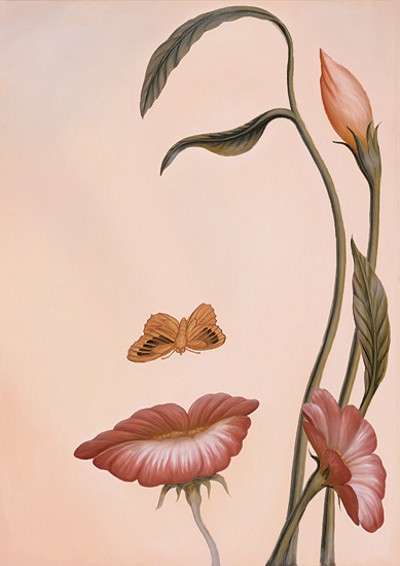
Occasionally I’ll run across something botanically relevant there, such as this interesting piece of botanical art:

botanical art illusion

There’s a similar image here.

2007 Year in Review

rosie]I’m pretty sure Pam over at Digging thinks that imitation is the sincerest form of flattery. She beat me to the punch with her Year in the Garden post. But honest, I was thinking about doing the same here.

I committed to really give blogging some effort last winter. (I started the blog in August 2005. But it took awhile for me to get into the habit.) So there wasn’t much in the way of gardening to post about last January. ‘Rosie’ (right) took up residence in my office (where I wrote a popular article about the warm winter, hitting 59 F on Jan. 6), Cal Lane’s artsy shovels caught my eye, I ordered my veggies seeds, and blogged about music. I may have lost my lunchbox, but I’m still here.

In February, blogging was still slow. I praised weeds mined images from 2006, and reviewed Anna Pavord’s The Naming of Names.

swamp milkweed
Swamp milkweed.

heuchera and lysimachia
Heuchera and lysimachia

In March, the gardening season kicked in along with the spring ephemerals. I love to watch them as the snow retreats. I discovered Iris histrioides ‘Katharine Hodgkin’ had hitchhiked in with some minor bulbs from a friend. I enjoyed the floral foreplay that is March. I couldn’t get Duncan Shiek’s White Limousine out of my head.

<em />Iris histrioides ‘Katharine Hodgkin’
Iris histrioides ‘Katharine Hodgkin’

crocus
Crocus

tulips and cyclamen
Tulips and cyclamen.

April was a busy month. It hit 64 on the 3rd and the peepers came out in force. The early spring bulbs flowered in profusion. I reviewed Amy Stewart’s Flower Confidential. Kurt Vonnegut died. I did my first bloom day scan. We got hit by the Tax Day Nor’easter and Jade had a ball in the snow. I discovered that you could see my pickup truck from the aerial photos at local.live.com. I snarkily reviewed garden footwear. And turned 50.

Chionodoxa and verbascum
Chionodoxa and verbascum.

April bloom day scan

Me, Corey and Fred by the water garden.
Me, Corey and Fred by the water garden on my 50th.

In May, there were mulch races outside my office window. Such joy does spring bring to students’ hearts. We visited our son in Jacksonville, Fla., May 9. It was 69 F there. 81 F in Ithaca. Go figure. The rescued tulips bloomed, as did primulas, the double bloodroot and other spring favorites. In the wetland, the lone crabapple and marsh marigolds did their thing. I visited my friend Marguerite at MotherPlants nursery, where she and her partner supply the burgeoning green roof trade.

Mulch races.
Mulch races.

Rescued tulips
Rescued tulips

Primulas
Primulas

Lone apple
Lone crabapple.

Demo dog houses at Mother Plants.
Demo dog houses with green roofs at Mother Plants.

I kicked off June, with an exploration of sex, antiquities and modern garden statuary in bondage in Honey, does this peplos make my butt look fat? My Early June picture purge will fill you in on what actually was going on in the garden. I had fun with Fun with fish and Photoshop. I celebrated the saving of the pink famingo factory, the anniversary Doc Ellis’s LSD-fueled no-hitter and the release of my favorite CD of 2007, Gogol Bordello’s Super Taranta. Also took my best garden picture to date. June is all about the light.

Nectoscordum
Nectoscordum

First peony from seed.

Fun with fish and Photoshop.

Acoustic version of Supertheory of Supereverything

June light, borrowed scenery

July. High summer. Cuisse de Nymphe roses. Verbascum. More great weeds. Sunsets. From Idiocracy, Brawndo’s got what plants crave. A Living Wall Installation. Lots of bees, despite CCD. Pink filipendula.

Cuisse de Nymphe roses.
Cuisse de Nymphe

Verbascum.
Verbascum

Sunset.
Sunset.

Bee on echiniceae.
Bee on Echinacea

Bee on verbascum.
Bee on verbascum.

Pink filipendula.
Pink filipendula.

In August, I ‘Simpsonized’ myself. The bananas in the garden outside my office made a statement, along with the blue alliums. I went to a tomato tasting to sample crosses between modern cherry tomatoes and heirloom varieties. There was a surfeit of purple in the garden. I made a floral mandala.

Me simpsonized.
Me Simpsonized. I should have added more gray.

Bananas in Minns Garden

Experimental cherry tomatoes.

Echiniceae
Echinacea

Floral mandala
Floral mandala.

September. I played around with video to record plants in motion. A sod sculpture went up at Bluegrass Lane. Saw Nanci Griffith at the State Theater. Considered what statuary might look like in the garden. But September is really the month for grasses.

Statue in the garden.
If I could afford statuary.

September bloom day scan.

Secret garden anemone.

September morn'.
September morn’.

Water garden.
Water garden.

Grasses.
Grasses

October brought Colchicum autumnale ‘Alboplenum’ and Eupatorium purpureum ‘Joe White’. Cover crops blanketed the veggie garden. The Dalai Lama visited Ithaca. Al Gore won the Nobel Peace Prize. First frost came the 16th. We discovered that the beavers had been busy. Fall colors were only mediocre. Janis Ruksans shared his bulb expertise with our rock garden group.

Colchicum autumnale ‘Alboplenum’

Eupatorium purpureum ‘Joe White’

cover crops
Cover crops in the veggie garden.

Frosted dahlia.
Frosted dahlia.

Mediocre fall color.

Scilla armena, Photo by Janis Ruksans, used with permission.

In November, Bill Millers perennials class planted a bulb labyrinth at Bluegrass Lane. Jay Hart’s ‘Terrain art’exhibition opened at Mann Library. Mornings were frosty. Textures got fuzzy. I shot Art of Horticulture class projects.

Bulb labyrinth at Bluegrass Lane
Bulb labyrinth at Bluegrass Lane.

Transitions by Jay Hart, used with permission of the artist.

Variegated Polygonatum

Frosty morning.
Frosty morning.

Fuzzy grasses.
Fuzzy grasses.

December’s short days featured bittersweet, the mystery of the Christmas Amanita, and I confessed to my houseplant problem.

bittersweet
Bittersweet.

In the Liberty Hyde Bailey Conservatory.

December Bloomg Day scan: Bittersweet and lunaria.

Thanks to all of you who stopped by and shared comments, as well as all you lurkers out there. Best wishes for a safe, healthy and peaceful New Year.

Christmas Amanita

Christmas Amanita

We used to have an old, very bizzare Christmas decoration that we inherited from somewhere on my wife’s side of the family. It was made from some kind of early synthetic rubber material, and had Santa riding in his sleigh landing on this huge red mushroom. I never really got it. We just thought it was weird.

This morning I was listening to the podcast of yesterday’s Thom Hartmann radio show, and he related this story: Though he did not identify the mushroom by name, the fly agaric (Amanita muscaria) grows in association with evergreen trees in the boreal forest. It is both poisonous and hallucinogenic.

But apparently reindeer can metabolize the toxin and excrete the hallucinogen unscathed. So Norse shamans would cultivate the mushrooms, encourage the reindeer to eat them, gather up the yellow snow and make a psychoactive brew.

And you wondered where the jolly man in the red suit, flying reindeer and elves from the North Pole got their start.  I think we should thank the Amanita.

Hartmann’s story differs from the Wikipedia entry, which has the reindeer prancing from the effects of the agaric. But it still makes the connection between Amanita and Christmas traditions.