Click images for larger view.
Yesterday, for the first time in seven years, the front door through the towering art-deco facade of Cornell University’s Mann Library swung open. A procession of library workers and well-wishers lead by a bagpiper marched in for a ceremonial opening of the newly renovated building.
Since the original building was completed in 1952, Mann has been recognized as one of the great agricultural libraries of the world, unifying the collections scattered around the College of Agriculture and Life Sciences and what was known then as the College of Home Economics (now Human Ecology).
Workers and staff are still putting finishing touches on the interior. For me, the job will not be done until the art work in the original building as I remember it as a grad student (circa 1980) is restored.
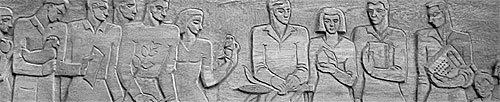
My favorite is the Elfriede Abbe frieze (detail above), as described on the Mann Library website:
One of the most remarkable of these pieces in the original building is a 31-foot frieze, designed and carved by renowned artist and sculptor Elfriede Abbe, which was installed on one end of the 2nd floor’s Current Periodicals Reading Room as an anonymous gift to the library in 1956. Human figures on the frieze denote individual disciplines in the study of agriculture and human ecology, and the sculpture as a whole celebrates the scientific and educational contributions these fields make to the quality of life.
Then there are these huge wood inlay pieces:
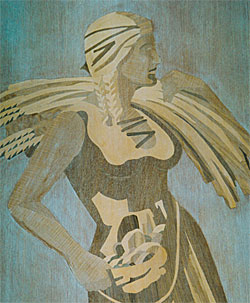
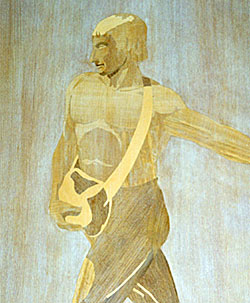
Also notable are the two gracefully stylized human figures depicted in wooden inlay panels on opposite ends of the 2nd floor card catalog hall. Shortly after the building’s opening the State Architect of the New York commissioned these two figures to evoke the agrarian foundations of the College of Agriculture and Life Sciences. Two members of the State Architect’s office (Frisbie Sanders, designer, and Frances Hector, detailer) used six tropical hardwoods to create the figures.
I have fond memories of wandering the old metal stacks at Mann. I’d start out looking for one thing but then something else more interesting would beckon from a nearby shelf. (I was particularly fond of the older books that opened a window on farming in the old days.) The experience was not unlike surfing the Internet.
While the building houses books, there is a 21st century library spirit that is as much concerned as giving students the tools they need to interact with the information and with each other as it is with housing knowledge. I’m intrigued by one early plan for the renovation that didn’t fly: Digitize all the books and use the entire space to foster human collaboration.
If five or ten years from now that seems like a wise way to go, I think the building will once again gracefully adapt.